Prayer. O God, within whose patient providence we exist, by whose enduring love we are embraced, with whose strength we are sustained, and by whose Spirit we are empowered to live and do good in the world, we give thanks for every blessing bestowed so generously upon us.
Bless our own efforts in the service of others, and bless for our use the food and fellowship we enjoy. Use us as willing instruments of your will.
Amen.
Club Announcements
Birthdays and Anniversaries
Birthdays
Kevin Hughes Mar. 01
Anniversaries
None
Membership Anniversaries
Virginia Carlton 11 years, Feb. 27
Mark Green 33 years, Mar. 01
Joe Harris 46 years, Mar. 01
Charlie Johnson 25 years, Mar. 01
Edley Jones 19 years, Mar. 02
Rich Sun 8 years, Mar 02
Trost Friedler 10 years, Mar. 04
Stanley Simpson 10 years, Mar. 04
Rotary Foundation Thought. This week’s Rotary Foundation Thought is the March 2018 Presidential Message from RI's 2017-2018 President Ian H. S. Riseley
This month marks 50 years since the first Rotaract club was chartered, in 1968. In the special Rotaract issue of The Rotarian, you’ll meet some impressive Rotaractors from around the world and see some of the incredible ways they are Making a Difference. In the half-century since Rotaract began, the world has seen profound changes, and young people have felt the greatest impact of those changes: the rise of technology and the information economy, the spread of education, and the tremendous influence of the internet. When Rotaract was founded, it would have been almost unthinkable for a teen or 20-something to have been an entrepreneur or a CEO. Today, young people have an unprecedented capacity to achieve – and Rotary needs their ideas and enthusiasm as never before.
For many years, Rotary has done Rotaract a disservice by looking at our youth and young adult programs as mere precursors to Rotary membership, and not as valuable and productive programs in their own right. But Rotaractors are truly partners in Rotary service.
Today, an estimated quarter of a million Rotaractors serve in over 10,000 clubs, in nearly every country where Rotary clubs exist. The impact of their service is particularly impressive when contrasted with their resources. Rotaractors achieve an amazing amount with far less money at their disposal than the average Rotary club. Their energy and vision bring something wonderful to our Rotary family and to our communities, and we value that very much.
Yet only 27 percent of Rotary clubs sponsor a Rotaract club, a figure that has remained fairly stable over time. And far too few Rotaractors ultimately do move on to Rotary membership. As we celebrate this anniversary with Rotaract, I encourage all Rotary clubs to consider sponsoring a Rotaract club or to strengthen their ties with the clubs they already sponsor. Schedule regular joint meetings, run joint service projects, and reach out to Rotaractors – not only to ask if you can help, but to find out how you can work together. Know your Rotaract clubs and their members – and make sure that every Rotaractor knows that a Rotary club is waiting to welcome them.
For half a century, Rotaract has given young people a way to find the same connections with their communities, and the same value in service, that Rotarians find in Rotary. Rotaractors are connecting us to the Rotary of our future, while helping us build the Rotary of today.
.
Billy Brumfield House. The Rotary Club of North Jackson is serving supper once a month at The Billy Brumfield House, a Stewpot Community Services ministry. Our club serves on the 1st Tuesday of each month. Interested members need to meet @ Baker Donelson located at the corner of Eastover Drive and the I-55 North Frontage Road @ 5:15 PM and then travel together to Billy Brumfield. Also, if you are interested in sponsoring a month, the est. cost is $180 for the food. Mike Dawkins is project chair and can be reached @ 601-351-2428 or dawkins@bakerdonelson.com.
Between the Lions. Please remember to sign up for Between the Lions. During the school year, we read weekly to pre-Kindergarteners at William Walton Elementary School on Bailey Ave. It is a wonderful experience! The children are truly information sponges and very willing learners. Contact Jenny Price (662) 213-1294 for more information. We have resumed reading and are really enjoying it.
Member Care Committeereminder: for anyone who needs assistance getting to a meeting, please call Luther Munford at (601) 985-4418.
Thinking of Proposing a New Member?
First, discuss with Classification Committee (Paul Miller or Julian Carroll). They will provide a member- ship application, check classification availability and discuss occupational qualifications.
Rotary Membership Occupational Qualifications Applicant should be one of the following:
A corporate officer
A Professional (Attorney, CPA, Physician. Engineer, Architect, etc) A Proprietor
An Agent of a reputable company
A Manager or Supervisor of a department or section of a business
Rotarians, don't forget to like the club's Facebook page to stay up to date on the latest happenings. Search us out at Rotary Club of North Jackson or click the link:
Lindsey Pointer facilitates a connection circle using a talking piece.
By Lindsey Pointer, Rotary Global Grant Scholar
During the recent U.S. government shut down, a bipartisan group of roughly two dozen senators helped craft the funding deal to reopen the government. The group used a “talking stick” as a tool to facilitate their meeting, only allowing the senator with the stick to speak in an effort to cut down on interruptions.
The use of the talking stick originated in Indigenous North American customs and is today also commonly used in restorative practices such as the circle, a process used to build connections and resolve disputes in community. Sometimes the talking stick is replaced by another object that has special significance to the group or facilitator using it. For example, I have heard a story of a group of construction workers having a difficult conversation about workplace safety using the hard hat of a deceased workmate as a talking piece to pass around in the circle.
Regardless of the object used, the talking piece ensures the equal voice and respectful communication necessary for cooperation.
The story about the senators got me thinking about other restorative principles and practices used by restorative justice organizations I have worked with. I have learned a few key strategies from working with these groups.
Lesson one
Always make time for relationships.
Every meeting with our whole staff begins with a connection circle in which each person answers a relationship-building question. Our staff takes turns facilitating those circles and picking the question and talking piece. The work always gets done, but plenty of time is made to laugh together, to check in about our lives, and offer support.
Above all else, restorative practices prioritize the building and maintaining of healthy relationships. We all have a want and a need to feel belonging and the only way to accomplish that is through opportunities for genuine connection. Research has shown that when we feel connected, heard, and appreciated at work, productivity increases. Having positive relationships with the people you work with also makes it easier to collaborate and compromise.
Lesson two
Establish a productive way to deal with conflict and remain open to feedback.
A Restorative conversation is a way of addressing one-on-one conflict that focuses on the impacts of an issue and what can be done to make things right moving forward. Longmont Community Justice Partnership trains volunteers in this method so they have a restorative way to resolves disputes among themselves over unreturned phone calls or differences in facilitation styles. Because staff members are all trained in the model, they have a tool for dealing with conflict and it doesn’t fester or come up again later passive aggressively.
Lesson three
Listen and show you are listening.
Active listening is a pillar of restorative practices. Facilitators are taught to show that they are listening through eye contact, body language, questions, and reflective statements. Active listening fuels cooperation.
Bringing the values, principles, and tools of restorative practices into our daily lives, families, and work communities allows us to create a social environment conducive to cooperation. Like the simple but powerful talking stick, these practices foster healthy community interactions.
Adapted with permission from the "Peacebuilder" Newsletter by District 5440
About the author: Lindsey Pointer is a restorative practices facilitator, trainer, and researcher. She is pursuing a PhD. in Restorative Justice at Victoria University in New Zealand with support from a Rotary Global Grant Scholarship and the Fulbright Program from the U.S. State Department.
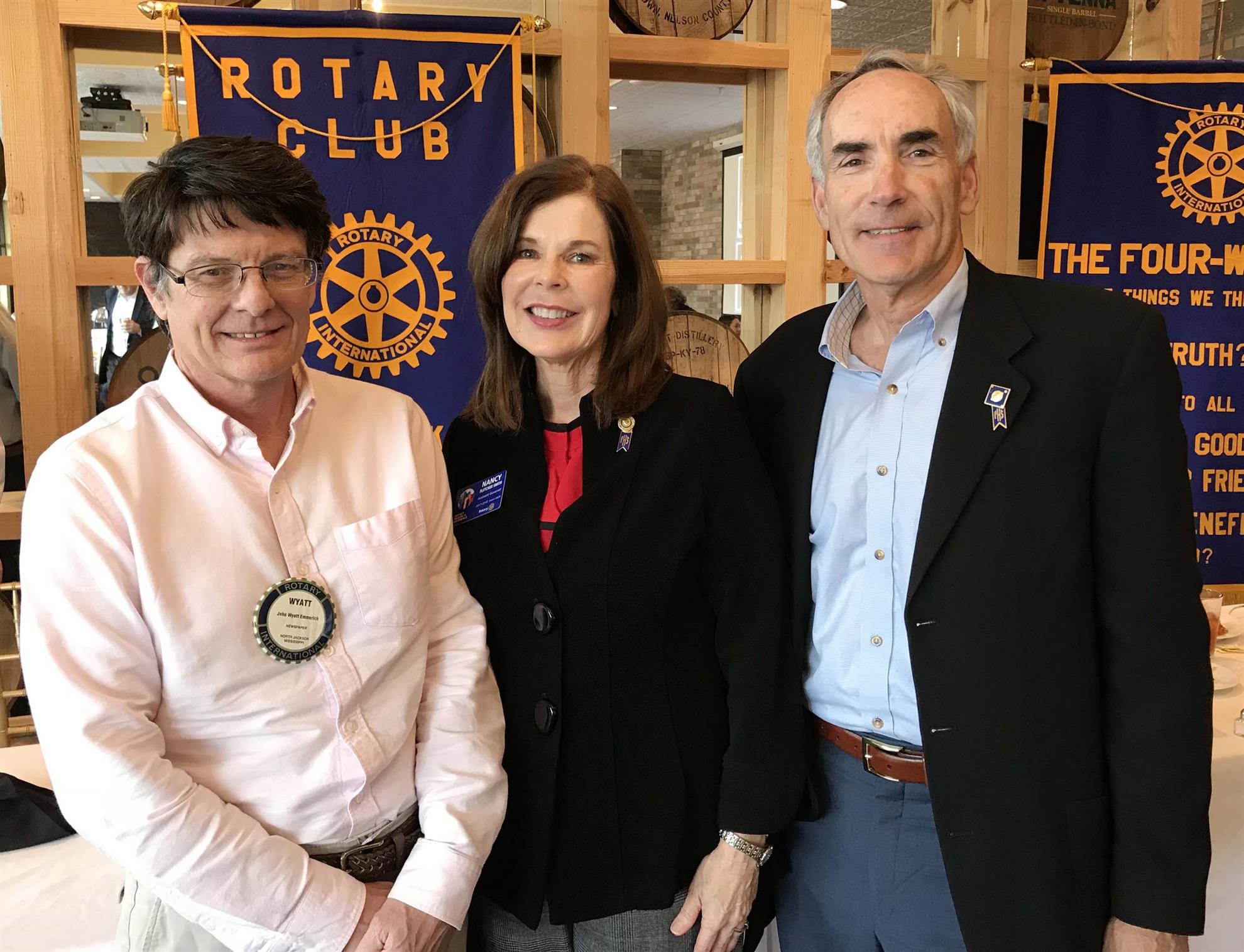
Rotary Club of North Jackson Past President Wyatt Emmerich, was recognized as a Paul Harris Society member during the club’s meeting on February 20, 2018. The Paul Harris Society recognizes Rotary members and friends of The Rotary Foundation who contribute $1,000 or more each Rotary year to the Annual Fund, PolioPlus Fund, or approved Foundation grants.Nancy Smith, Assistant Rotary District 6820 Governor and Mark Fields, Rotary District 6820 Paul Harris Society Coordinator, presented Emmerich with his pen. Shown from left, Emmerich, Smith and Fields.
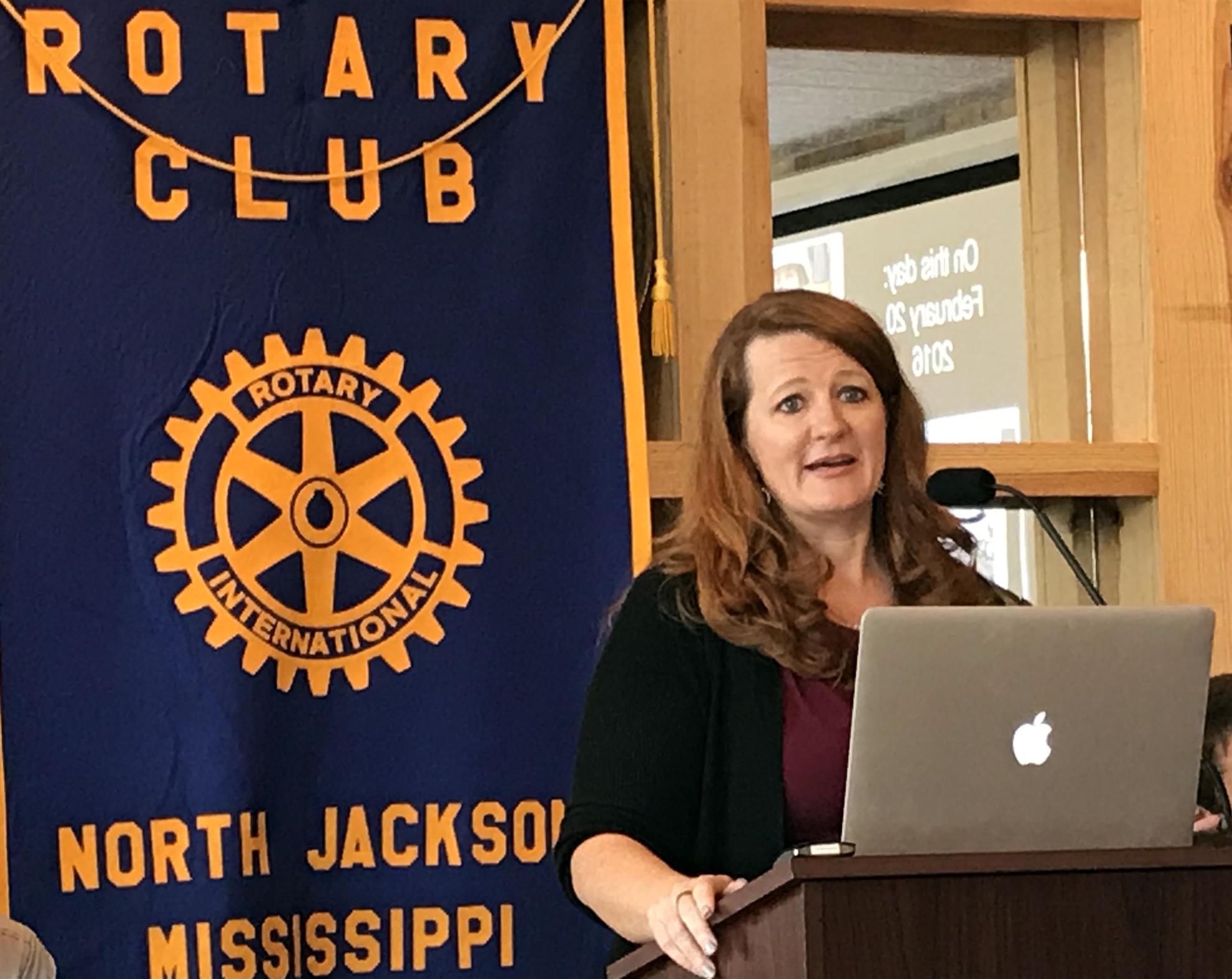
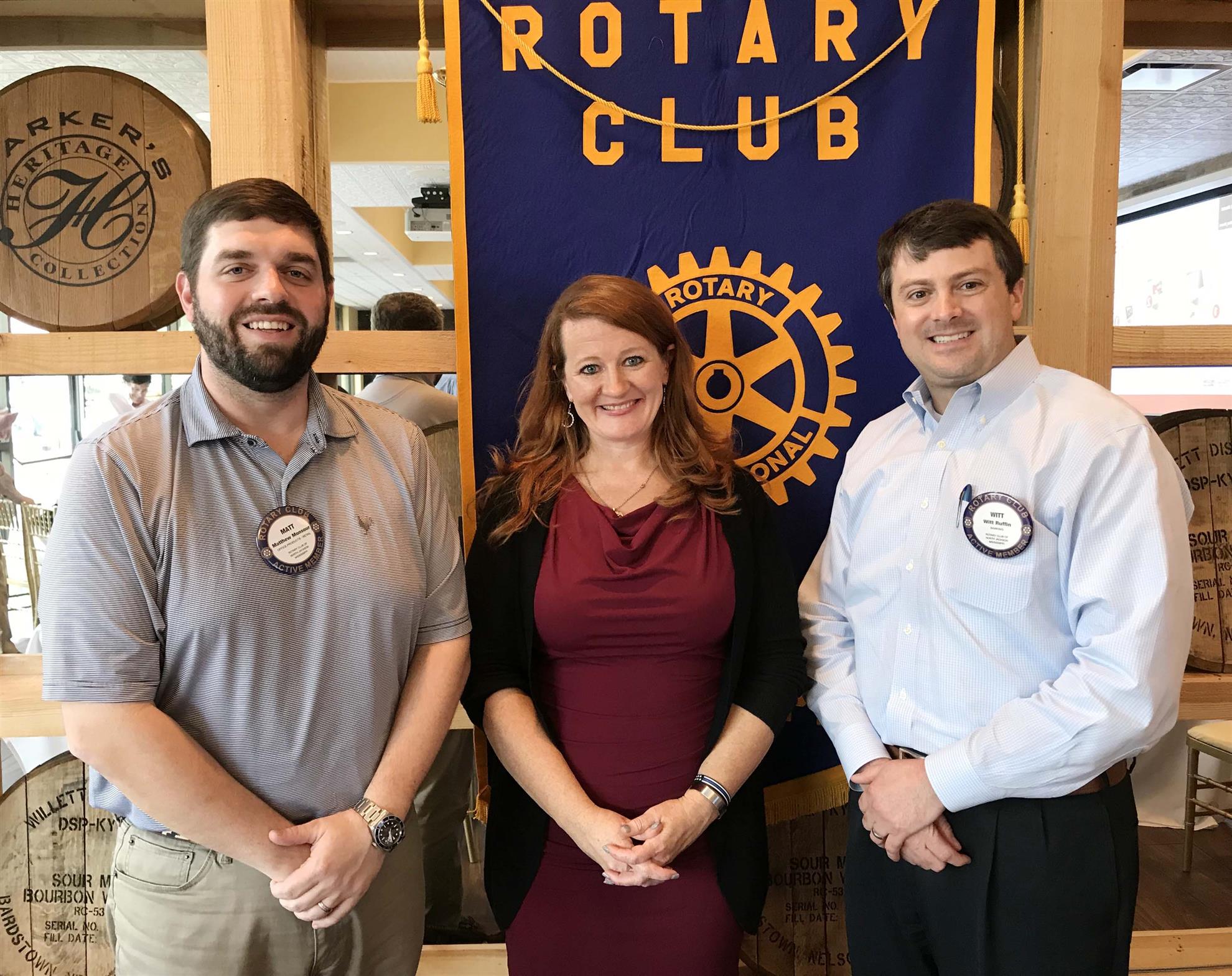
Therese Apel, a crime reporter for The Clarion-Ledger, spoke to the Rotary Club of North Jackson during its February 20, 2018 meeting. Apel shared some of her biggest stories that she has covered while at the Clarion-Ledger. One top story she covered was the mass murders in Brookhaven in May of 2017. She is shown in the two accompanying photos.
One at the Lectern during her presentation and the second with Matt Monsour (left) who introduced here and Club President Witt Ruffin. We thank her for her presentation and for her service as a reporter for the Clarion-Ledger.
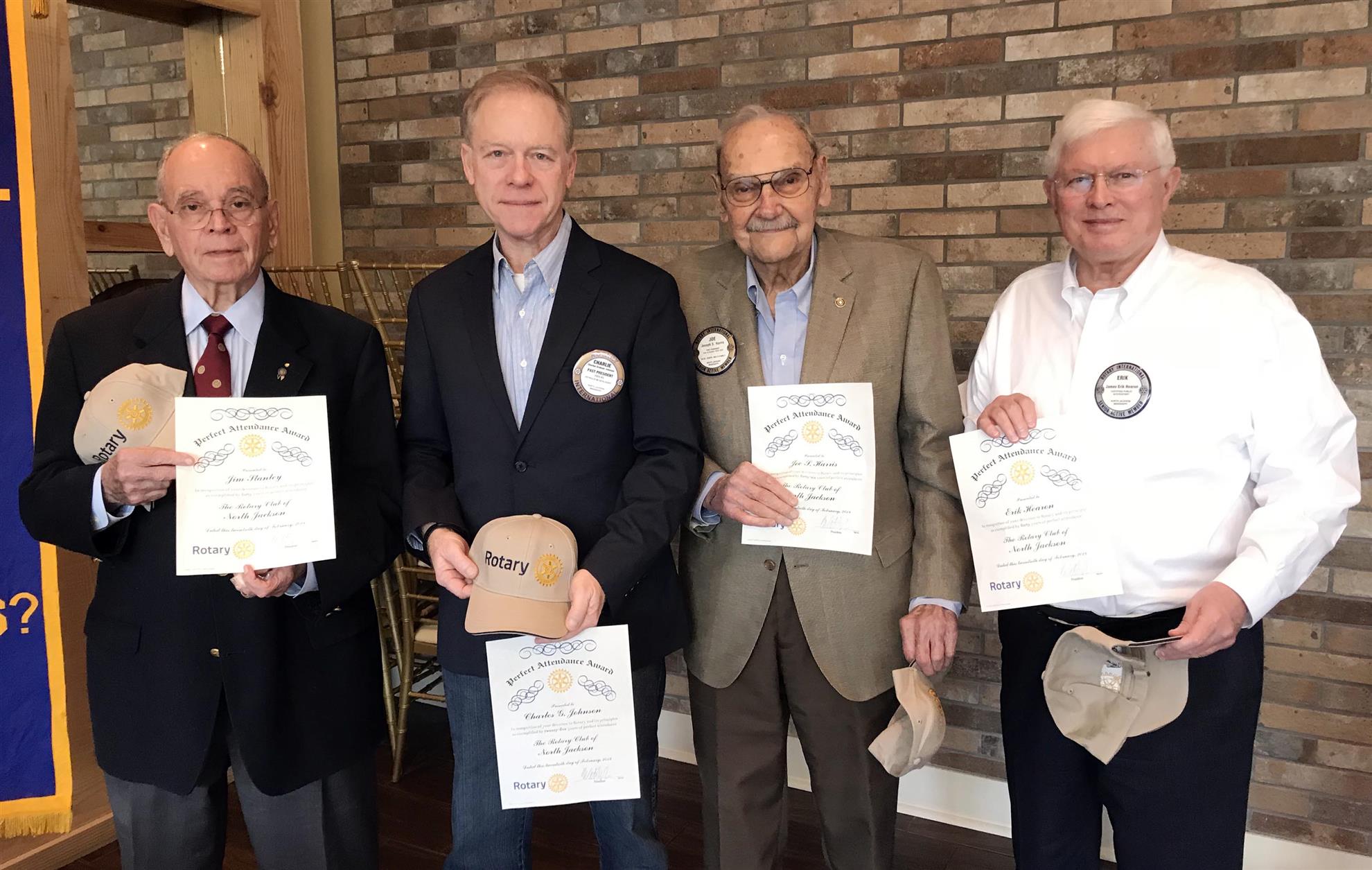
Four members of The Rotary Club of North Jackson were recognized during its February 20, 2018 meeting with a combined 148 years of perfect attendance. Shown from left, Jim Stanley, 37 years; Charles Johnson, 25 years; Joe Harris, 45 years and Erik Hearon, 40 years. Congratulations and thanks for your years of dedicated "Service above self."
Ms. Jenny Williams and Ms. Ashley Lucas of the Mississippi Analysis and Information Center (MSAIC) spoke to the Rotary Club of North Jackson at its February 13, 2018 meeting. Ms. Williams discussed the MSAIC, its role, mission and goals. Ms. Lucas discussed the center's work to stop human trafficking. Per the brochure distributed by them, the Mission of the MSAIC is " to provide Mississippi with a centralized location for the gathering, analysis, and sharing of information from local, state, tribal, and federal resources to prevent criminal activity including acts of terrorism, or other threats to public safety. MSAIC serves as the integrated multi-discipline sharing network for situational awareness and is a key component of the jurisdiction's homeland security and crime prevention efforts." The goals of the MSAIC are as follow:
Maximize Mississippi's law enforcement and public safety agencies' ability to detect, prevent, apprehend, and respond to criminal and terrorist activities.
Support an all-crimes, all-hazard, all-threat's approach to intelligence.
Collect, analyze, disseminate real time criminal intelligence information to operational and executive elements.
Reduce duplication of effort.
Support intelligence led policing and national security strategies/dissemination of information collected from across Mississippi and the U.S.
Support critical infrastructure protection strategies.
We thank Ms. Williams (second from left) and Ms. Lucas (second from right) for their presentation and for their service to the citizens of Mississippi. They are shown following their presentation in the accompanying photo along with Rotarian Matt Monsour (left) who introduced them and their presentation and Club President Witt Ruffin (right).
Jackson, MS author, Jackie Warren Tatum, spoke to the Rotary Club of North Jackson at the club’s February 6, 2018 meeting. Ms. Tatum discussed what it takes to become a published author and she discussed some of Rotary’s key accomplishments as viewed by a non-Rotarian.
She said that once a work is completed, you need to find an agent who will in turn help you find a publisher. Her book, entitled “Unspeakable Things” was published by Mill City Press and is available from Amazon and Lemuria Books in Jackson.
With respect to Rotary, Ms/ Tatum cited the success that Rotary has had in helping eliminate Polio from the world. Thus far it has achieved a 99.9% reduction since 1985 when there were 350,000 cases worldwide. In 2017, there were about 20 cases, mostly in war-torn, developing countries. She also noted the work that Rotary has done in fighting illiteracy, particularly in the U.S. with North Jackson participating in the Dictionary Project and in Between the Lions where Rotarians read to Pre-kindergarten children and in drilling and maintaining water wells in Africa where nonpotable water is an endemic problem. Prior to having wells, citizens have to walk multiple miles to wells that are generally unsanitary.
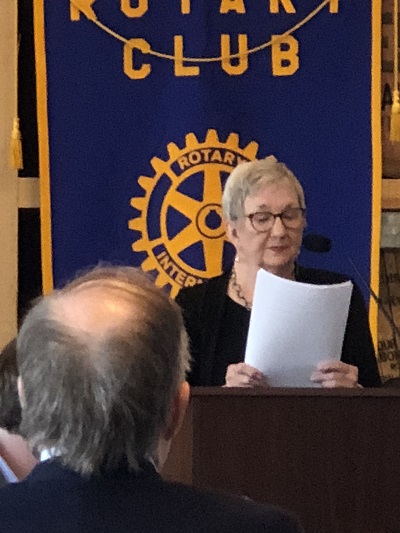
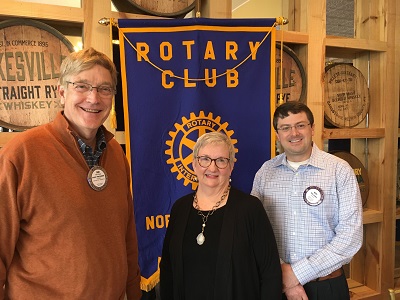
We thank Ms. Tatum for her presentation and for her interest in the work that Rotary does. She is shown in the accompanying photos at the podium during her speech and after it with Club Past president Tom Parry (left) and 2017-2018 President Witt Ruffin (right).




.png)