

New Englanders, Nigeria clubs aid Boko Haram refugees
By Marty Peak Helman, District 7780 Foundation Chair
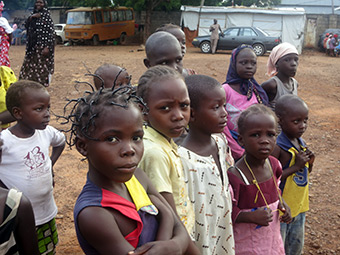
Children in a refugee camp in eastern Nigeria.
The American University of Nigeria (AUN) was
co-founded by Rotarian Felix Obadan in 2000,
and 12 years later, when Felix was governor
of Rotary’s District 9125, which covers a large
portion of Nigeria, he chartered the Rotary
Club of Yola-AUN on campus. Their strong
influence on campus makes it not surpris-
ing that many University professors and
senior staff are Rotary members, and that
the University prides itself on its work to-
ward peace, entrepreneurship, and eco-
nomic development as well as its strong
academics.
The University’s mission is to graduate
students prepared to take on the chal-
lenges in Nigeria and throughout West
Africa – challenges of climate change,
development, and peace building. And
peace is not an abstract concept at the
university. After all, it is located in Yola,
the capital of Adamawa State, in the
region where Boko Haram is most
powerful. In fact, those few dozen
Chibok schoolgirls who escaped from
being kidnapped by Boko Haram are
now safely living at the University,
where they are receiving social ser-
vices and education.
Boko Haram has brought me to the
American University of Nigeria as well.
I am here as part of a team from Ro-
tary’s District 7780 in New England to
meet with the two Rotary clubs in Yola,
and to visit Rotary projects including a
camp for internally displaced families
in flight from Boko Haram. It is our in-
tention to see what we can do in terms
of a global grant to help them.
Putting together a global grant
will not be easy. The needs of the
people living at the camp are immed-
iate, and it is hard to think in terms
of long-term sustainability. Food, for
example, is a continuing problem.
The men are agricultural workers and
are eager to get back to working the
soil, but even if they could rent land
near to the camp, it’s hard for them to
think ahead to next year’s crop. One
non-governmental organization gave
the men seed for planting, we are told,
but because their children are hungry,
the seed was promptly cooked and eaten.
The families at the camps – who are
there because they have fled their vil-
lages for their lives – are living testi-
mony of the need for us, their neigh-
bors, to strive for peace.
Meanwhile, while they wait for political
change, the women weave craft items to
sell out of the plastic bags that litter the
sides of the road, and the children –
many of whom have been out of school
for several years while their families
have been on the run – attend a govern-
ment school near the camp.
Still, I find myself very optimistic about
being able to craft a global grant to help
these families. After all, the Yola clubs
know the camps intimately, and have
both the contacts and the resources to
understand what will work best. Our
Districts – 9125 in Nigeria and 7780
in New England – have worked to-
gether for over a decade, with National
Immunization Days, a Group Study Ex-
change, and both matching and global
grants to our credit.
This is what Rotary is all about –
developing relationships that span the
globe and make possible long-term
humanitarian change. And the fam-
ilies at the camps – who are there be-
cause they have fled their villages for
their lives – are living testimony of the
need for us, their neighbors, to strive
for peace.
Please note that our website address
has been updated to:
www.northjacksonrotary.org